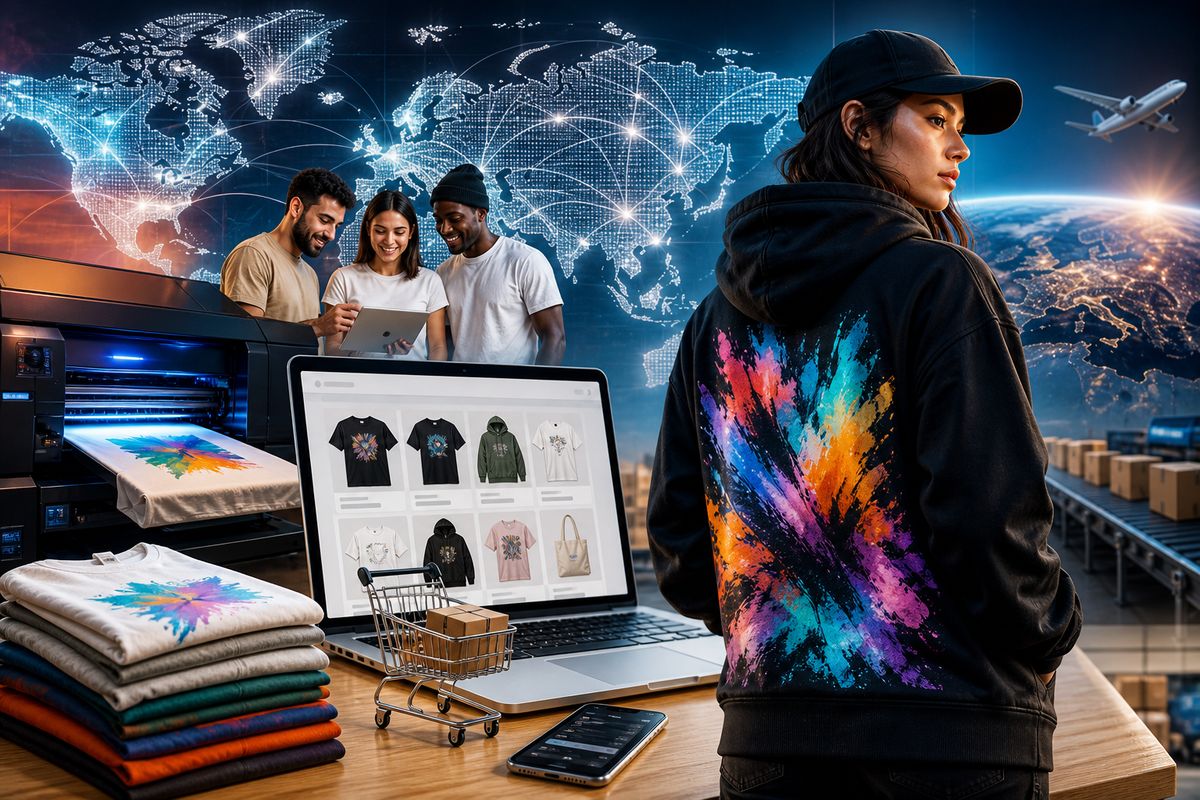
Print on demand in 2026 moves from side hustle to serious retail
Print on demand is no longer the slightly scrappy option for creators who cannot afford inventory. In 2026, it sits squarely in the mainstream toolkit for anyone looking to launch an online clothing store quickly, test demand, and scale without a warehouse. That shift is not happening in a vacuum. It is being pushed along by three forces that are now hard to ignore: booming online fashion sales, the rise of social-led product discovery, and the steady productisation of fulfilment platforms that make “start a brand” feel almost frictionless.
The clearest signal comes from the platforms themselves. Printful’s 2026 guide frames the moment bluntly: “there’s never been a better time to launch an online clothing store”, pointing to global fashion eCommerce sales projected to surpass $1.2 trillion by 2030 and an apparel market valued at $1.8 trillion in 2025 on its way to $2.5 trillion by 2033 (figures cited in Printful’s article at https://www.printful.com/blog/the-basics-of-starting-an-online-clothing-store). Printify, meanwhile, positions print on demand as “the leanest, fastest way to launch a clothing brand”, while still acknowledging the trade-offs in control and margins (https://printify.com/blog/how-to-start-a-clothing-brand/).
And then there is the storefront layer. Spreadshop is explicitly selling the idea of a free, ready-to-go merch shop with no inventory and “48-hour fulfilment”, plus global ordering and “20+ years of experience” (https://www.spreadshop.com/free-merch-shop/). Put those messages together and the 2026 development is clear: the industry is standardising around a low-friction launch path, and the competitive edge is shifting from “can you manufacture?” to “can you research, position, and sell?”
The 2026 development: platforms converge on a faster, lower-risk launch model
The story in 2026 is not a single corporate announcement, it is a market-wide convergence. Printful publishes an “8 steps” blueprint for starting an online clothing store with low upfront costs and no inventory, explicitly steering founders towards models like print on demand, dropshipping, or wholesale. Printify publishes a parallel “7 steps” guide, again emphasising that founders do not need a fashion degree or a massive budget, and that print on demand is an efficient way to test ideas and launch limited drops. Spreadshop goes one step further, marketing a free storefront that can be live “in minutes”, with integrated e-commerce features and social connectivity.
What makes this a genuine 2026 development, rather than the same old “start a brand” content, is the way the platforms now anchor their advice in measurable market dynamics. Printful highlights that the US print-on-demand market is forecast to grow at a 24.4% CAGR through 2030, and that TikTok, Instagram, and YouTube drive over 60% of product discovery, ahead of Google search (as cited in Printful’s guide). Those are not minor claims. They reshape the order of operations for a new clothing business: audience and distribution come first, then product, then the operational model that best matches the founder’s risk tolerance.
Spreadshop’s pitch adds another layer: speed and reliability as a selling point. It advertises 48-hour fulfilment, “consistent quality control checks”, and “personal support day or night”. It even offers an indicative earnings range, stating that “many sellers earn $5 to $15 per product” on high-demand items like t-shirts and hoodies, depending on pricing and selection. That is not a promise, and it should not be treated as one, but it does show how platforms are trying to make the unit economics feel legible to first-time founders.
In practical terms, the 2026 shift is this: the barriers to launching are now so low that the bottleneck moves to differentiation. Anyone can open a shop. Not everyone can build a brand people actually care about. And that is where the next sections matter.
Background: Printful, Printify, and Spreadshop, and why their guidance matters
Printful and Printify are both prominent print on demand players, but they approach the founder journey slightly differently in their 2026 guidance. Printful’s article is structured as an end-to-end “online clothing store” build, covering niche selection, market research, product design options, store setup, SEO, and promotion. It explicitly recommends using tools such as Google Trends and Semrush to compare search volume for styles, and suggests scanning Etsy, Instagram, TikTok, and Reddit communities to spot gaps and recurring themes (all referenced as tactics within Printful’s guide at https://www.printful.com/blog/the-basics-of-starting-an-online-clothing-store).
Printify’s guide leans more heavily into brand fundamentals and operational discipline. It stresses that there is no “one-size-fits-all formula” and frames the key early decisions as: who the brand is selling to, which business model fits, and how to avoid quality issues by ordering samples. It also draws a clear line between print on demand and the “traditional model” where a brand holds inventory or works directly with suppliers, noting the trade-off: print on demand offers low startup costs and simplified logistics, while traditional approaches offer more control, higher profit potential, and stronger brand identity (as described at https://printify.com/blog/how-to-start-a-clothing-brand/).
Spreadshop is positioned a little differently again. It sells itself as a ready-made, free storefront with “modern design, mobile-first shopping”, social connectivity, and a catalogue of “300+ print on demand products”. It also lists multiple print methods, including digital direct, embroidery, and thermosublimation for items like mugs and water bottles. In other words, it is not just a fulfilment partner, it is trying to be the whole front door for a merch business (https://www.spreadshop.com/free-merch-shop/).
Why does this matter? Because when three different players all push the same core message in 2026, the market is telling founders something: the operational layer is becoming commoditised. The competitive advantage is increasingly in research, positioning, creative direction, and distribution, especially social distribution.
How to start an online clothing store in 2026, the playbook platforms are standardising
The platform guidance is remarkably consistent. Printful’s “8 steps” and Printify’s “7 steps” are not identical, but they rhyme. Both insist that founders must start with a defined target audience, validate demand with research, choose a business model that matches budget and appetite for risk, and then build a store that converts. The interesting part is not the checklist itself, it is what the checklist implies: the “fashion” part is only half the job. The other half is retail mechanics, content, and performance marketing.
On niche and audience, Printful is explicit about why specificity wins. A niche is framed as a style, theme, or audience focus that makes it easier to stand out and attract loyal fans. It even gives examples that feel very 2026: cottagecore dresses for plant mums, bold graphic tees for indie horror fans, retro workout sets for 80s lovers, minimalist streetwear for “tech bros”. The point is not the aesthetics, it is the discipline. A niche constrains product decisions, messaging, and content, which in turn makes marketing more efficient.
On research, both guides push founders away from “I like this” thinking and towards validation. Printful recommends comparing search volume via Google Trends and Semrush, and scanning marketplaces and social platforms for gaps. Printify recommends watching what is trending across Google Trends, TikTok, Instagram, and Pinterest, checking competitors, and spotting what is missing or feels inauthentic. Neither source provides a universal benchmark for “good” search volume or conversion rates, and it would be irresponsible to invent one. But the direction is clear: founders should treat research as a prerequisite, not a nice-to-have.
On business model selection, the sources outline three common routes: print on demand, dropshipping, and wholesale or traditional inventory-led approaches. Printful describes print on demand as low risk, with no inventory and fulfilment handled by the provider, but with lower margins and less control over quality, unboxing, and delivery speed. Printify echoes those trade-offs and adds a strategic nuance: print on demand is ideal for testing ideas, launching limited drops, and starting with minimal risk, while traditional models better suit long-term brands that want signature styles, custom packaging, and deeper control over fabric and fit.
Industry analysis: why print on demand is accelerating, and where the risks sit
Three data points from Printful’s 2026 guide explain the acceleration better than any hype ever could. First, global fashion eCommerce sales are projected to surpass $1.2 trillion by 2030. Second, the US print-on-demand market is forecast to grow at a 24.4% CAGR through 2030. Third, social platforms now drive over 60% of product discovery, ahead of Google search (all cited in Printful’s article). Taken together, they suggest a market where demand is moving online, fulfilment is being outsourced, and attention is being captured on social feeds rather than search results pages.
That last point is a big deal. If TikTok, Instagram, and YouTube are genuinely leading product discovery, then the winning clothing brands in 2026 behave more like content studios than catalogue operators. They design products that are easy to communicate in a short video, build narratives around identity and values, and use rapid iteration to keep up with micro-trends. Print on demand supports that cadence because it reduces the cost of being wrong. A brand can test a graphic tee concept, see what sells, and double down, without sitting on boxes of unsold stock.
But the risks are real, and the platforms themselves admit it. Printful notes that print on demand can mean lower profit margins and limited control over product quality, unboxing, and delivery speed. Spreadshop’s promise of 48-hour fulfilment is attractive, but it is still a dependency. When fulfilment is outsourced, the brand is only as strong as the partner’s consistency. And when the barrier to entry is low, competition is brutal. The market fills with lookalike designs, thin brand stories, and paid social campaigns that burn cash without building loyalty. Not exactly groundbreaking, but it catches new founders every year.
There is also a strategic tension between speed and brand equity. Printify argues that traditional models can offer stronger brand identity and higher profit potential, precisely because they allow control over materials, packaging, and fit. In other words, print on demand is often the best way to start, but it is not automatically the best way to finish. Many successful brands will likely treat print on demand as the validation engine, then shift some bestsellers into bulk production once demand is proven and the economics justify it.
Historical context: from Shopify-era DTC to the social-first, fulfilment-as-a-service age
Online fashion has been through a few distinct phases. First came the early eCommerce era, where the challenge was simply getting a functioning website and convincing people to enter card details. Then the direct-to-consumer boom made brand storytelling and paid social the growth engine, with many labels holding inventory and building logistics capabilities in-house or via third-party logistics providers. Now, in 2026, the playbook shifts again. Fulfilment is increasingly abstracted away, and the storefront can be spun up in minutes. Spreadshop’s “free set up” pitch is basically the logical endpoint of that trend.
What changes in this phase is the balance of power between operations and marketing. Historically, apparel brands built moats through manufacturing relationships, supply chain efficiency, and retail distribution. Those still matter, fair enough, but the sources here show a different emphasis: research tools, SEO, social discovery, and rapid product testing. Printful explicitly calls out store setup elements like intuitive navigation, smart pricing, SEO, and platform-appropriate visuals. That is not fashion school advice. That is digital retail advice.
There is also a cultural shift that the sources nod to, even if they do not quantify it. Printful states that “younger shoppers are moving away from established brands toward labels with better products, stronger values, or a more personal shopping experience”. No hard numbers are provided in the source for that claim, so it should be treated as directional rather than definitive. Still, it aligns with what print on demand enables: smaller brands, more niches, more identity-led micro-communities, and more experimentation.
The comparison worth making is not to legacy fashion houses, but to the creator economy. Print on demand turns audience attention into merchandise quickly. Spreadshop even positions itself as a way to “keep it social” and sell directly through socials or link an existing website. That is the 2026 reality: distribution is increasingly owned by individuals and communities, and the supply chain is increasingly rented.
What This Means For You
For founders and marketers, the practical implication is simple: in 2026, starting is easy, winning is hard. The operational barrier is lower than ever, thanks to print on demand providers and free storefront tools. But that means the market punishes vague positioning. The smartest move is to pick a niche that is narrow enough to own, then validate it with research before spending time on designs. Printful’s suggested workflow is sensible here: use Google Trends and Semrush to sanity-check demand, then scan Etsy, TikTok, Instagram, and Reddit communities to see what people are actually asking for and what they cannot find. That research becomes the brand’s unfair advantage, because most competitors will skip it.
Next, treat the business model as a strategic choice, not an identity. Print on demand is excellent for testing, limited drops, and reducing inventory risk, as both Printful and Printify emphasise. But it comes with trade-offs in margin and control. So the actionable approach is to plan for phases. Phase one: launch with print on demand, order samples early (Printify explicitly recommends this), and focus on content and conversion. Phase two: once a small set of products proves demand, consider whether moving those winners into a more traditional model could improve margins and brand experience through better packaging, fabric control, and delivery predictability.
And finally, take social discovery seriously, because the sources say it now drives over 60% of product discovery. That should change how a brand builds its store and its content. Product pages need visuals that work on mobile. The brand needs short-form video assets that explain the product in seconds. And the product line should be designed with shareability in mind, not just aesthetics. In a social-first world, the best product is often the one that is easiest to talk about.
Closing thoughts: the new advantage is not printing, it is judgement
The 2026 print on demand story is, at heart, a story about leverage. Platforms like Printful and Printify package up production and fulfilment so founders can focus on brand, research, and marketing. Spreadshop goes further by packaging up the storefront itself, promising a free shop, social connectivity, and fast fulfilment. For the industry, this pushes competition towards creativity, positioning, and audience-building, and away from operational scale as the primary moat.
But there is a catch, and it is worth stating plainly. When everyone can launch quickly, the winners are the ones with better judgement. Better niche selection. Better research. Better creative direction. Better content. Better pricing discipline. Print on demand makes it cheaper to learn, and that is powerful. It does not make the learning optional.
For anyone considering an online clothing store in 2026, the opportunity is real, and the numbers cited by Printful underline the scale of the market. The path is also clearer than it has ever been. The hard part is doing the unglamorous work, validating demand, ordering samples, building a store that converts, and showing up on social consistently. That is where brands are made, or quietly abandoned.