Farmers market products are no longer just weekend treats, they are launchpads
In 2026, the story of farmers market products is increasingly the story of modern food entrepreneurship. A stall selling sourdough on a Saturday morning, a table stacked with jars of salsa, a cooler full of cold brew, these are not simply charming local scenes. They are, in many cases, the earliest stage of a brand that can scale, travel, and build a loyal following well beyond the market car park.
The latest vendor-focused guidance circulating in the sector is blunt about what sells and why. It points to a familiar set of categories that consistently perform: fresh produce, artisan baked goods, small-batch sauces and condiments, specialty meats and jerky, and coffee and beverages. None of that is shocking. But the more interesting development is the emphasis on what happens next, the shift from physical footfall to visibility beyond the market. That is where the competitive edge now sits (and where many promising stalls still stumble).
Alongside this, shopper education is becoming more formalised. A Florida farmers’ market factsheet, part of a wider series designed to improve safety and marketability, lays out practical shopping behaviours: plan ahead, bring reusable bags and coolers, carry cash in smaller denominations, and use EBT/SNAP where available. It also defines what a farmers’ market is, citing the Farmers Market Coalition’s 2025 definition: a public, recurring assembly of farmers or their representatives selling agricultural products directly to consumers, in a fixed location, open to the public with a regular schedule. That definition matters because it anchors the whole proposition: direct sales, direct trust, direct feedback.
The 2026 development: from “top-selling categories” to a playbook for growth
The immediate news development is not a single corporate acquisition or a splashy funding round. It is more structural than that, and arguably more consequential for the thousands of small operators trying to make the leap from side hustle to serious business. The vendor guidance now being promoted in the market ecosystem frames farmers’ markets as a repeatable pathway: start with a product that fills a niche, show up consistently, build word-of-mouth, then expand through online discovery so customers can find the brand outside market hours.
That “missing piece” language is telling. For years, the standard advice to vendors has been about product quality, pricing, signage, and sampling. All still important, fair enough. But the 2026 framing puts discoverability at the centre of the growth model. The logic is simple: a vendor is capped by the number of people who physically walk past the stall. Online visibility, by contrast, is not limited by the market’s opening hours, weather, or seasonal foot traffic. It becomes a second storefront, and in some cases the main one.
There is also a subtle but important shift in how markets are described. The vendor guide lists markets across the United States and includes operational details that matter to both shoppers and sellers, such as the Appleton Downtown Farm Market running Saturdays, 8 AM to 12:30 PM, June to October 2026, and the Durham Farmers’ Market operating Saturdays and Wednesdays with specific hours across April to November. Several listings note SNAP participation, signalling that payment infrastructure and accessibility are not side issues, they are part of the commercial engine.
Put together, the 2026 development is best understood as a maturing of the farmers’ market model. It is not just “sell locally”. It is “use local as the proving ground, then build systems that let the business travel”. And that changes how vendors should think about product selection, packaging, compliance, and marketing from day one.
Why certain farmers market products keep winning, and what that reveals
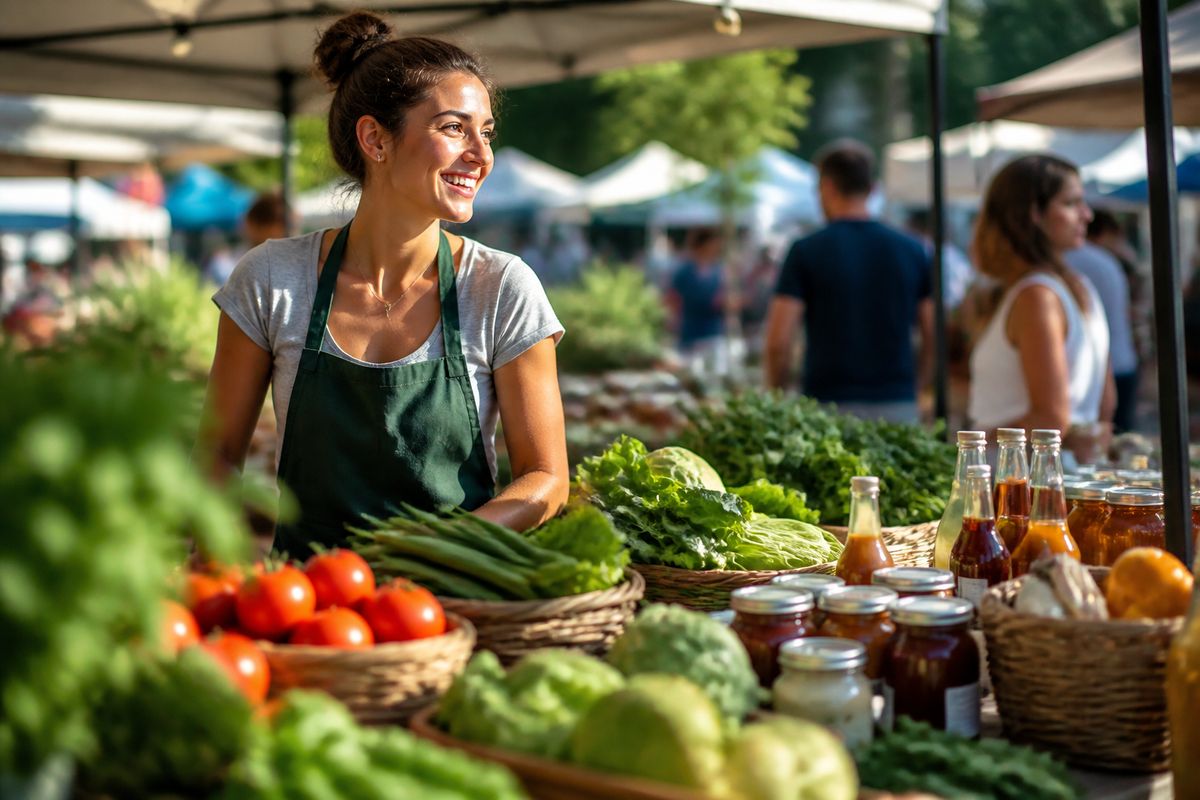
The categories highlighted as consistent top sellers are not random. They share characteristics that make them well-suited to the farmers’ market environment: they are easy to understand at a glance, they signal freshness or craft, and they invite conversation. Fresh produce remains the backbone because it is seasonal, visually compelling, and habit-forming. People do not buy tomatoes once. They come back next week for more, and that repeat behaviour is the closest thing a small vendor has to predictable revenue.
Artisan baked goods are described as one of the fastest-selling categories at most markets. That makes sense in practical terms: baked goods are portable, immediately consumable, and often purchased on impulse. They also create a sensory halo around a stall, the smell of bread and pastries does marketing work that signage cannot. But baked goods also reveal a constraint: they are labour-intensive and time-sensitive. Scaling them usually requires process discipline, equipment investment, and a careful approach to shelf life.
Small-batch sauces and condiments, including hot sauces, salsas, jams, and dressings, are a different kind of winner. They start as “small recipes” and can grow into full-scale brands precisely because they travel well. A jar can sit in a cupboard. It can be shipped. It can be stocked. And it can carry a brand story on a label. The same logic applies to specialty meats and jerky, which the guidance calls out for long shelf life and strong margins. Shelf life is not glamorous, but it is a big deal for cash flow and waste reduction.
Then there is coffee and beverages, especially cold brew, fresh juices, and specialty drinks in high-traffic markets. Drinks do two things at once: they monetise footfall and they keep shoppers on site longer. A market that becomes a social destination sells more of everything. Vendors in this category, however, face operational complexity: cold storage, food safety practices, and the need for speed during peak hours. In other words, the category is attractive, but it is not “easy money”.
The organisations and systems shaping the modern farmers’ market ecosystem
Farmers’ markets have always been about community, but in 2026 they are also about systems. The Florida factsheet positions itself as part of a broader educational series aimed at managers, vendors, and shoppers, with explicit goals around regulations, best practices, and marketing. That combination is revealing. It suggests markets are increasingly managed like professional retail environments, not informal gatherings. Safety, consistency, and customer experience are treated as levers for growth, not box-ticking exercises.
The factsheet’s definition of a farmers’ market, attributed to the Farmers Market Coalition in 2025, emphasises the direct-to-consumer model and the fixed, recurring nature of markets. That matters because it distinguishes farmers’ markets from pop-ups, festivals, and general craft fairs. The definition also underlines the economic rationale: by selling without middlemen, farmers can earn more, and shoppers can buy fresh local food, which can boost the local economy. The source material does not quantify that boost, and it would be wrong to invent numbers. But the mechanism is clear: margin stays closer to the producer.
Payment and access systems are also becoming more visible in market operations. The factsheet advises shoppers to bring cash because some vendors still prefer it, while acknowledging that more vendors accept major cards and other payment forms. It also highlights EBT/SNAP usage and a Florida-specific matching programme, Fresh Access Bucks (FAB), described as providing a one-to-one match for Florida-grown produce. That is not just a shopper perk. It is demand stimulation, and it can materially change a vendor’s sales mix on market day.
And then there is the emerging layer of vendor listings and “findability” tools promoted by market-adjacent platforms. The vendor guidance is explicit: the hardest part is building a product people love; the next step is helping more people find it. In practice, that means vendors are being nudged to think like modern retailers, with consistent branding, searchable presence, and a story that travels beyond a face-to-face chat at the stall.
Industry analysis: the real battleground is visibility, not just flavour
For years, the romantic narrative around farmers’ markets has been about authenticity. That still sells. But the 2026 reality is more competitive and more operational. When multiple stalls offer excellent bread or attractive produce, differentiation shifts to repeatability and reach. The vendor guidance spells it out: growth comes from word of mouth, repeat customers, and increasingly, online visibility. That “increasingly” is doing a lot of work. It signals a market where the best product does not automatically win if it cannot be found outside a narrow time window.
This has knock-on effects across the value chain. Vendors who want to scale must design products for consistency, packaging, and compliance earlier than they might expect. Sauces and condiments are popular not only because they taste good, but because they are structurally scalable. Jerky and other shelf-stable meats are highlighted because they combine margin potential with logistics advantages. Even fresh produce vendors, traditionally the most “local-only” operators, are being pulled towards pre-orders, subscriptions, and other models that reduce reliance on walk-up traffic. The source material does not detail these models, so the point here is directional: visibility enables new sales formats.
Shopper behaviour is also part of the competitive landscape. The Florida factsheet encourages shoppers to arrive early for the freshest items and to walk the whole market before buying, comparing prices and discovering new products. That is good advice for consumers. But for vendors it means something else: the first impression matters, and so does the ability to convert browsers who are explicitly shopping around. Sampling, clear pricing, and a crisp product story become essential, because shoppers are not captive.
And there is a wider industry implication: farmers’ markets are increasingly a testbed for product-market fit. The vendor guidance describes a simple formula, a product that fills a niche, a local audience that provides feedback, and consistent presence to build recognition. That is essentially lean startup thinking applied to food. The market becomes a live focus group, and the vendors who treat it that way can iterate faster than those who simply “turn up and hope”.
Historical context: from community stalls to brand incubators
Farmers’ markets have long served as community infrastructure, a place to buy seasonal food and meet the people who grow it. What changes over time is the role they play in the broader food economy. The source material frames markets as starting points for some of the most successful small food businesses in the United States, where a simple booth can grow into a recognisable brand with loyal customers. It does not name specific brands, and none should be added. But the pattern is familiar across regions: a product gains a following locally, then finds routes into wider distribution.
Historically, the limiting factor was distribution. A stall could only sell to people physically present. Scaling often required wholesale relationships, retail listings, or significant capital. In 2026, the guidance suggests a different bridge: online discovery that allows customers searching for local products, farmers’ markets, or specific vendors to find them. That does not eliminate the hard work of production and fulfilment, but it lowers the barrier to being noticed. In plain terms, the market stall is no longer the only shopfront.
There is also a long-running tension between craft and scale. Artisan baked goods and small-batch condiments trade heavily on the idea of hand-made quality. Scaling can threaten that perception if it is handled clumsily. But the modern consumer is not necessarily anti-scale; they are anti-blandness and anti-opacity. Vendors who maintain ingredient integrity, keep their story consistent, and communicate clearly can grow without losing credibility. The sources do not provide case studies, so the comparison remains conceptual, but it reflects the direction of travel in the sector.
Finally, the increasing formalisation of shopper guidance, including safety and handling, reflects a broader historical trend: as farmers’ markets become more economically significant, expectations rise. Shoppers want the charm, yes. But they also want reliability, clear rules, and safe food handling. Markets that deliver both tend to become destinations, and destinations create the footfall that helps vendors graduate from hobby to business.
What This Means For You
For aspiring vendors, the 2026 lesson is straightforward: choose farmers market products with a clear path to repeat sales and, ideally, a path to scale. Fresh produce and baked goods can build loyal weekly customers, but they demand operational discipline and can be constrained by shelf life. Sauces, jams, dressings, and jerky are highlighted for a reason: they are easier to stock, easier to transport, and easier to sell beyond the market day. That does not mean everyone should pivot to hot sauce. It means vendors should be honest about what they are building, a weekend stall, or a business that can grow legs.
For regular shoppers, the practical guidance is not just about convenience, it shapes the market’s success. Planning ahead, bringing reusable bags and coolers, and carrying cash in smaller denominations makes transactions smoother and reduces friction for small operators. And for eligible households, using EBT/SNAP at participating markets, and taking advantage of matched produce programmes like Florida’s Fresh Access Bucks, can stretch budgets while directing spend towards local growers. That is a rare win-win, better access for shoppers, stronger demand for producers.
For market managers and local organisers, the takeaway is that “marketability” now sits alongside safety as a core responsibility. Clear operating hours, consistent rules, and visible payment options matter because they reduce uncertainty for shoppers and vendors alike. And if the market wants to be more than a pleasant Saturday outing, it needs to help vendors be discoverable beyond the site. That can be as simple as ensuring vendor information is accurate and consistent wherever people search, and encouraging stalls to tell their story in a way that can be found later, not just heard once in passing.
Closing thoughts: the stall is the start, but the strategy decides the outcome
The most useful thing about the current wave of farmers’ market guidance is that it treats small vendors like serious businesses in the making. It identifies the product categories that reliably sell, but it also points to the real constraint: being limited to the people who happen to walk through the market. In 2026, that limitation is optional, at least for vendors willing to build visibility and consistency alongside flavour and craft.
At the same time, the shopper education material is a reminder that farmers’ markets are ecosystems. Vendors do not succeed in isolation. Market managers set the tone and the rules, shoppers shape demand through habits and payment choices, and programmes like EBT/SNAP participation and matched produce incentives can widen access and stabilise sales. None of this is glamorous. But it is how markets move from quaint to resilient.
And perhaps that is the real point. Farmers’ markets are not just about nostalgia for local food. They are about building durable local commerce, one repeat customer at a time, then giving that commerce the tools to grow. The stall is the beginning. The strategy is what turns it into a brand.